Sketchbook and paintings of X
A ManX’s sketchbooks and paintings are modest landscape studies that become an intimate record of how he saw the world. Their unpolished, persistent work moves Rié to tears by returning her to a past she had not expected to meet again, and later gives Kido a way to recognize X’s gentleness and seriousness. The drawings matter not because they display mastery, but because their very lack of polish makes them feel like a mirror of their maker.
The sketchbooks and their subjects
On a weekday evening, after returning to Rié’s shop, Daisuké offers her two sketchbooks. Their green covers are dog-eared and their corners whitened from being carried everywhere. With Rié’s mother away and no other customers present, the books become a private introduction to a man whose name Rié still does not know.
The first page shows Aoshima, an island in Miyazaki City: the rocky shore called Devil’s Washboard, its rippling terrain, the gate of Aoshima Shrine, and the broad ocean reflecting the blue sky, with the coast in the distance. As Rié turns the pages, the subjects widen beyond scenery that might catch a visitor’s eye. She finds cherry trees in full bloom on a burial mound, the dam at the edge of town, the Hitotsuse River, and a nearby park. The collection holds tourist sights beside places that local people might consider ordinary.
Some pictures are black and white, others in color. The work is competent without suggesting exceptional talent; its technique seems not to have advanced beyond the sort of drawing a person might have made as a schoolboy. Yet the sketchbooks are numerous, and the continued act of making them is the point. Where most people leave drawing behind after school, Daisuké has quietly kept filling pages as an adult, preserving an openness that Rié finds deeply moving.
The bus terminal and Rié’s memory
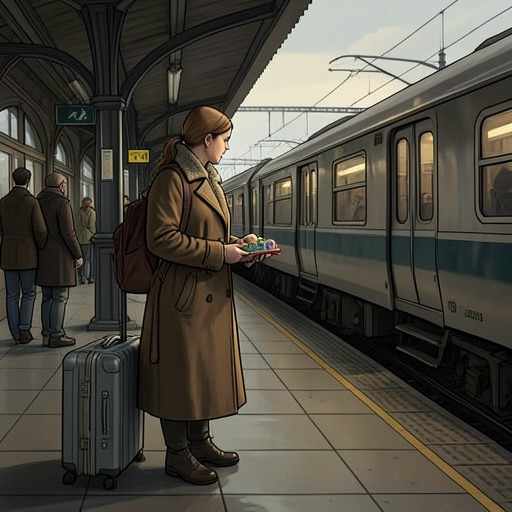
At the end of the second sketchbook, Rié comes upon a watercolor of the Miyazaki City bus terminal she used every day on her way to high school. She has been passing the terminal regularly again, but the picture makes tears rise before she can explain why. She wipes them away, embarrassed by the force of the response.
The image gathers more than the building. In retrospect, Rié understands her tears as the breaking point of grief and instability that had accumulated since her return home, including her sorrow for Ryo and her father. The terminal brings back the teenager who waited there each morning without imagining the life ahead: work in Yokohama, marriage, the loss of one of her two children, separation from her husband, and a return to her hometown.
Fifteen years have passed, but the watercolor preserves the terminal much as it remains in her wistful memory. What has disappeared from the scene is the schoolgirl herself. The drawing’s quiet accuracy makes the gap between then and now newly visible: an ordinary place has become the measure of a life Rié could not have foreseen. The picture does not explain her past for her; it gives that past a form she can suddenly feel.
A shared response
Rié tells Daisuké that he is talented and apologizes for crying, explaining that the familiar place seems to have reminded her of something long ago. She carefully closes the sketchbook so her tears will not wet it, covers her mouth, and takes a few moments to regain her composure. The care with which she protects the picture contrasts with the emotion it has released.
Daisuké has stood silently as she turns the pages. Then tears spill from his reddened eyes as well. He cowers behind a shelf, as if something secret has been exposed; when he returns, he has picked up a red pen, and the tears are gone. Neither of them explains what the moment means. While he waits for her to ring up the pen, both remain quiet, and Rié cannot bear to break the tenderness that has settled over the shop in the gathering dusk.
The drawings thus become more than a gift or a display of artistic persistence. They create a meeting between two people through an image that belongs to Daisuké but touches Rié’s buried memories. Their shared tears do not resolve either person’s history; their significance lies in the recognition that passes between them without an adequate explanation.
Kido’s reading of the drawings
Much later, while Rié gathers X’s belongings, she tells Kido about their first meeting and describes X’s character. Kido studies the pages of X’s sketchbook collection and photographs them, along with other personal effects, in case they prove useful to the investigation. The act of looking is both attentive and practical: the pictures are evidence about a person whose background Kido is trying to establish.
Kido sees in them the work of a boy who became an adult without growing up. Rié agrees that they are not pictures to show off, but says they are like a mirror of X’s heart and mind: pure, serious, and giving, unlike the work of someone capable of deception. Her description makes the contrast between the drawings’ limited technique and their emotional force explicit. They do not prove an identity or settle the facts of X’s past, but they help Kido grasp the person Rié remembers and give their investigation a human dimension.
Significance
The sketchbooks repeatedly place the ordinary under sustained attention: a river, a dam, a park, a bus terminal. For Rié, the familiar is not simply scenery. Seen again through Daisuké’s patient drawings, it returns with the pressure of time, exposing the distance between her remembered youth and the life she actually lived. The books’ unvarnished style supports that effect: they do not transform their subjects into grand achievements, but preserve the maker’s continued, unshowy effort to look.
Their meaning also changes with their circumstances. First, they are offered privately to Rié, and one image opens an unexpected passage into shared grief. Later, as part of X’s belongings, they become objects Kido documents while pursuing the concealed background of their maker. Across both moments, the pictures offer a kind of access that is neither a confession nor a factual record: they allow other people to read X through the places he chose to draw and through the persistence with which he kept drawing them.